Where are the cicadas now?
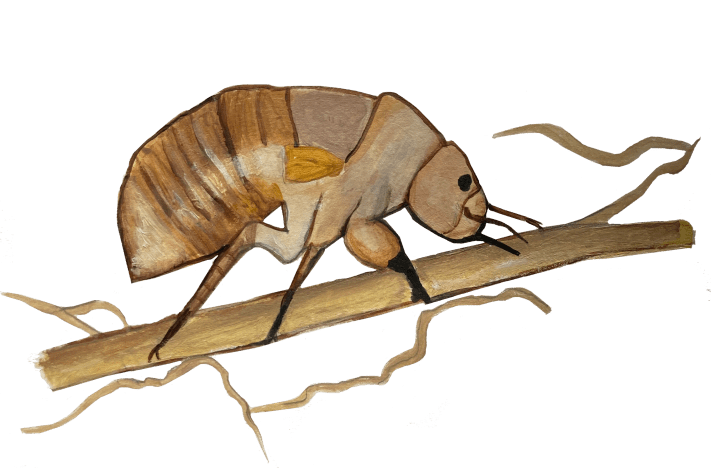
The fully grown periodical cicada nymphs are currently in small underground chambers about 8-12 inches below the soil surface beneath their host trees, where they have been feeding on root sap since they hatched from eggs and dug down into the soil, as long as 13 or 17 years ago! Host trees can be found in forests, parks, and even urban and suburban neighborhoods — wherever there are mature trees that were present during the last emergence.

When will they start emerging?
The nymphs typically start to emerge in late spring (late April – late May or early June, depending on the location of the brood), when soil temperature reaches approximately 18 degrees Celsius (64 degrees Fahrenheit). The nymphs mostly emerge from their underground tunnels at night, enabling them to complete their final molt into adult cicadas under the protective cover of darkness.


A cicada emerging and molting into the process of adulthood.
Photographed by Martha Weiss
How do they tell time?
We know part, but not all, of the answer to that question. Because developing cicada nymphs are tapped into the roots of trees, they can sense differences in the movement of sap in the roots throughout the year, and can count its seasonal pulses. They emerge after 13 or 17 cycles have passed. We don’t yet know how they keep track of how many years have passed.
Why are there so many?
The synchronous emergence of millions of adults all within a few weeks clearly works to satisfy or ‘satiate’ all available predators, ensuring that many cicadas will survive to reproduce the next generation. If, for some reason, a small portion of a brood emerges 4 years early (a common occurrence for 17-year cicadas), they typically don’t survive or reproduce well, because they get eaten by predators.
What do cicadas eat?
Cicadas are herbivores, which means that they eat plants. Their mouthparts are shaped like straws, which they insert into plant roots to drink liquid sap. Cicada nymphs sip sap from tree roots for the 13-17 years that they live underground. Once the adults emerge, they again feed on plant fluids by inserting their beaks into the trunks and twigs of plants. Because the plant fluids that they feed on are mostly water and not very nutritious, cicadas depend on special bacteria that live inside their bodies to provide the other nutrients and amino acids that they need to grow.
Why do they come up every 13 or 17 years?
That is still a bit of a mystery. Living for thirteen or seventeen years is a very long life span for any insect. In fact, periodical cicadas are among the longest living insects on record. It is likely that having long intervals between successive emergences helps to prevent potential predators from ‘tracking’ these cycles.
Do they ever get their triggers/signals mixed up and emerge early or late?
Yes! Broods of 17-year cicadas often contain a subset of individuals that predictably emerges 4 years early, a phenomenon that is not well understood. This early emergence is one way that the 13-year cicada species are thought to have evolved. Also, there are often a smaller number of individuals that emerge 1 year early; these early emerging arrivals are called ‘stragglers’, even though they come out early. Interestingly, the eyes of periodical cicada nymphs change from white to red the year prior to their emergence.
Why do they make so much noise?
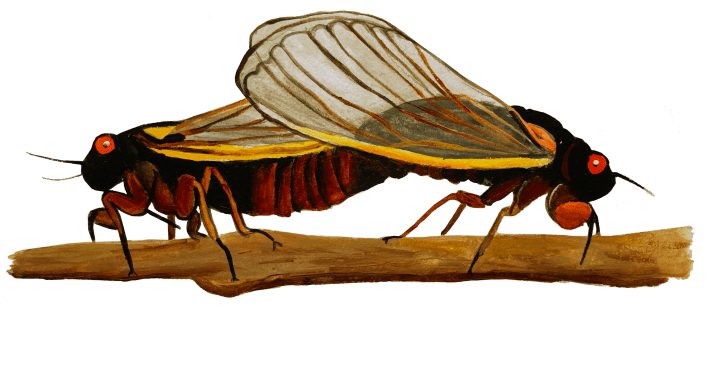
Male cicadas ‘sing’ by vibrating special organs on their abdomens called tymbals. The songs are produced to attract females as mates. The females will respond with a clicking noise if they like a male’s singing. Groups of male cicadas often congregate in the canopies of individual trees in what is known as a ‘chorus;’ their songs are among the loudest noises made by any insect.
Can cicadas hurt people?
Individual cicadas are quite harmless. They don’t have stingers or biting jaws, and they are not toxic or irritating. They are very awkward flyers so they may accidentally bump into you, but they can’t bite you – remember, they feed on plant fluids using special mouthparts that look like a drinking straw! If you pick them up, little spikes on their legs might tickle your hand. En masse, cicadas can present a risk to pedestrians and drivers, because when many cicadas die on sidewalks or roads, they can make the surface slippery. Walk and drive carefully when navigating large swarms.
Where do cicadas lay eggs, and when will the eggs hatch?
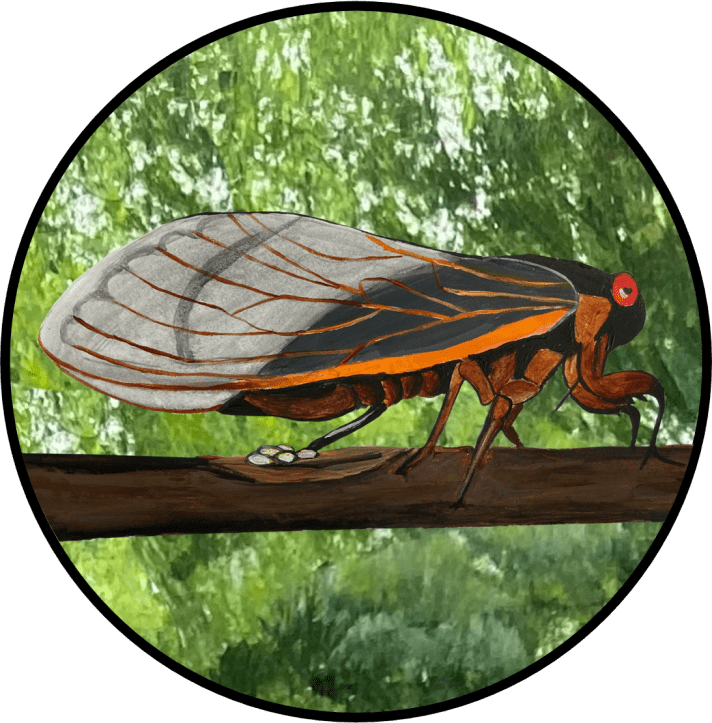
After mating, female cicadas will fly off in search of trees in sunny locations, often along the edges of woodlots or in suburban areas. They look for small twigs on the ends of branches that are about the diameter of a pencil, where they cut open a slit in the bark using a special structure for laying eggs, called an ovipositor. Inside of this slit, they lay about 20 eggs (called an ‘egg nest’) and each female will make many different egg nests, laying a total of several hundred eggs. The eggs take approximately 6-8 weeks to develop, typically hatching in mid- to late-summer.
Art by Zoe Getman-Pickering
Will they damage my plants?
Adult cicadas occasionally feed on fluids in the plants they perch on, but this does not damage the plants. However, female cicadas can damage the small branches of trees when they lay eggs, and in some trees, the ends of the branches will turn brown and wilt. This is called ‘flagging,’ and though on some trees the ends of many branches will flag, it is unlikely to seriously harm or kill the tree. Cicadas prefer to lay eggs on trees that get a lot of sunlight, so trees near the edges of forests or in open areas of yards can be prime targets. For homeowners, pesticides are ineffective, dangerous, and bad for the environment. A safer and more effective solution is to cover any young trees and shrubs in plastic netting that can then be removed following the emergence.
Who eats cicadas?
Many different species of birds, squirrels, chipmunks, mice, racoons, opossums, foxes, insects, and even fish will feed on them. Dogs and cats will eat them readily. Eating a few won’t hurt your pets, but if they eat too many it can make them constipated.
Can humans eat them?
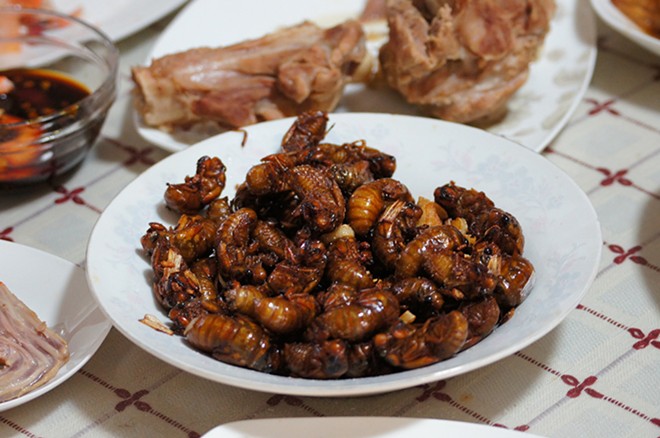
Yes! Cicadas are edible and have been historically eaten by settlers and native people alike. If you want to eat cicadas, we recommend collecting them at night just as the new adults emerge from their shells. They are less pleasant to eat after they have hardened up. Cook them before eating them. They can be tasty dried in the oven and covered in chocolate or included in a stir-fry with vegetables.

Jessica Koscielniak, USA TODAY
xiangrui huang/FlickrCC
How long do they live as adults?
In contrast to the immature nymphs, which feed belowground for 13 to 17 years, the adults live a very short time; those that survive predation are alive for about 3-4 weeks, just long enough to mate and reproduce.
Can I keep cicadas as pets?
It’s best not to capture cicadas or keep them as pets. They have been waiting for many years to reach this stage of their lives, and they should be allowed to fulfill their mission of producing the next generation. Instead of keeping them in a jar, why not find a spot with lots of cicadas outside where you can watch them in nature? You will get a much better understanding of how they act that way. It is okay to collect the shed exoskeletons, though!
Where did periodical cicadas come from?
Periodical cicadas evolved in North America, and are native to the eastern United States
How can I get involved?
Do you want to learn how to identify the different species of cicadas? Do you want to help scientists learn more about where the cicadas are? You can download Cicada Safari for iOS or Android to learn more about cicadas, identify them, and help with scientific research.
More resources!
More educational resources and information on cicadas can be found at Cicada Mania and at the University of Connecticut website.
For more educational materials, you can buy a wonderful book written by Martha Weiss and illustrated by Dio Cramer. This book is your trusty guide to the world of these fascinating insects, complete with surprising biological information, colorful illustrations, and even recipes for preparing your own cicada treats! Click HERE to link to an on-line bookstore.

 Periodical Cicadas